
Intro
It is nearly a year ago now, since I laid down my hard earned cash to purchase the Playdate by Panic. The small, yellow, low powered, handheld device with a monochrome screen and a strange crank, initially, seemed like nothing to write home about. It is so niche that if it hadn’t been designed with Teenage Engineering, a company whose products I love (but usually can’t afford), I would never have heard of it. Compared to other consoles by the likes of Nintendo, Sony or Microsoft, the specs are definitely lackluster. But I still love it because it was not designed to rival those powerhouses. It was designed to emulate the essence of gaming, like the Game Boy did back in the 1980s, and with its fun and quirky games, it does that brilliantly. And with their recent focus on education, I think they really have something to offer. Let's talk about it...
- Details
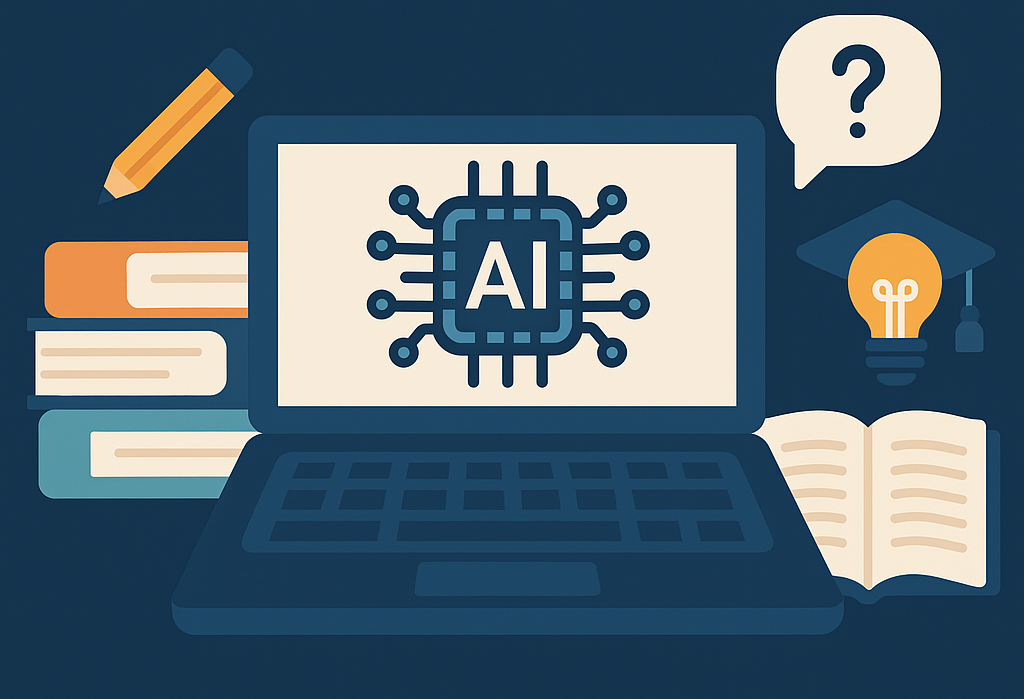
Exploring what generative AI really is, what it isn’t, and what that means for teachers and learners.
Before generative
Let’s step back for a moment and remind ourselves that AI has been used in education for a while already. Classification and recognition AI was central to Google’s Quick, Draw! Game (2016); Reinforcement Learning systems were demonstrated using Minecraft education edition through project Malmo (2016); Lego Spike Prime (2020) could be used alongside AI algorithms to understand sensor information and inform actions. When it comes to teacher use for productivity, predictive/analytical AI has been used in Knewton Alta, (2018) an adaptive learning platform that predicts student performance and recommends practice based on data; and ALEKS (McGraw Hill) delivers personalized practice based on student knowledge and performance (1999). Many now see generative AI as the next step up, with extra power, control and generative properties. However is that really the case?
Generative AI and the Illusion of Understanding
Generative AI does have a kind of magic to it, which is different from the other forms. Its responses are so human-like many have already been fooled into thinking it is human. But when looking through research papers and developer notes, and coming across its shortcomings, the truth is, it cannot really understand, at least not in the way that humans can.
- Details
AI in the Movies hasn't been all roses
It has been about 3 years since OpenAI thrust us into the era of mass adoption of Artificial Intelligence. Since then, the world has undergone a paradigm shift, for better or for worse. But let’s not forget that AI was around long before this and the term was initially coined over 70 years ago. AI is nothing new and our opinions of it have been forming over the last few decades. Unfortunately, many media and entertainment depictions of AI have garnered negative views, based on movies like '2001: A Space Odyssey' (1968); 'Blade Runner' (the 1982 one), which was based on the Philip K. Dick short novel 'Do Androids Dream of Electric Sheep' (1968); the Terminator movies (from 1984); 'I, Robot' - where the robot was actually good, but for most of the movie, the viewer was led to believe otherwise; 'The Matrix' (1999); 'Ex-Machina' (2014); and 'M3GAN' (2022) the only one in this list that I have not actually seen.
So what does this all mean for edtech, which is the purpose of this post? It means that those negative sentiments have now drifted into the minds of teachers, educators and parents. But do we really have anything to fear? Well, yes and no. Let me start with my less important (for this article) take on AI...
- Details
Read more: To AI or not to AI? - That Is No Longer The Edtech Question!
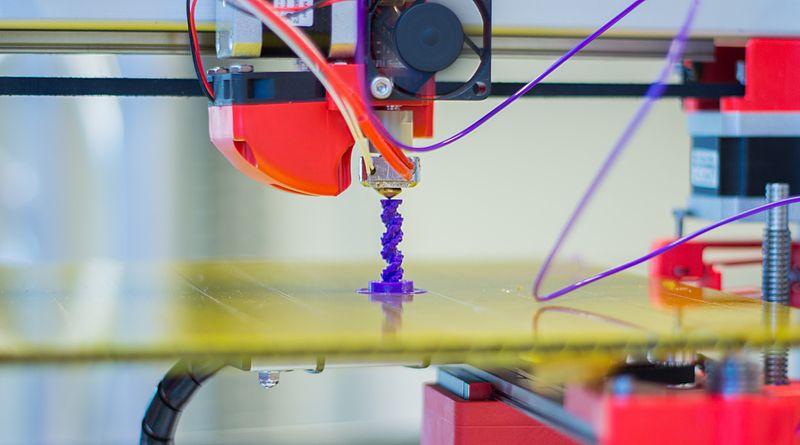
Welcome to part 5, the final part of the STEAM 3D printing series of posts. In the previous part, we covered 3D design software and coding. In this part, we will discuss the fine tuning of the model print, using slicer software which should cover science, technology, engineering, and mathematics. We will also cover the possible networking potential with 3D printing, which can be seen as an advanced option, but has lots of learning potential, and will cover the technology sides of STEAM.
- Details
Read more: 3D Printers - The Ultimate STEAM Machines: Part 5
Welcome to part 4 of the 3D printers series of posts. In part 1 we covered the basics of 3D printing as a STEAM project, and in part 2 we covered the building of a 3D printer, the electronics and keeping safe in an education environment. Part 3 was dedicated to the engineering, mathematics and art components of the enclosure and the scientific components of the 3D printing filament. In this part, we will cover the technology, art, mathematics, and engineering within the design of 3D objects using software, as well as the technology and mathematics within the programming of the 3D printing firmware.
- Details
Read more: 3D Printers - The Ultimate STEAM Machines: Part 4
Welcome to part 3 of the 3D printers series of posts. So far we have covered the basics of 3D printing as a STEAM project and covered the building of a 3D printer, the electronics and keeping safe in an education environment. In this part, we will cover the building of the enclosure and the raw materials used to print. This essentially covers engineering, mathematics, art, and Science.
- Details
Read more: 3D Printers - The Ultimate STEAM Machines: Part 3
Welcome to part 2 of this series, which will discuss how 3D printers cover a wide range of STEAM components in education. In part 1, I laid the groundwork and covered the basics, such as the history of 3D printers, the process of printing from start to finish and how the different aspects met the STEAM components.
In part 2, I will discuss building the printer and the electronics, along with the association Technology and Engineering components of STEAM.
- Details
Read more: 3D Printers - The Ultimate STEAM Machines: Part 2